

In this episode, we breakdown how to simplify complex partner ecosystems through actionable enablement strategies.
Meet our Guest
Merav is a Partner Enablement Leader who specializes in building trust, strengthening partner relationships, and creating programs that drive impact at scale. With a career spanning enterprises, service providers, strategic accounts, and diverse partner ecosystems, she brings deep expertise in aligning people, processes, and programs to help teams thrive.
Merav is most energized by the human side of enablement—fostering collaboration, mentoring emerging leaders, and amplifying voices that often go unheard. Whether she’s designing global programs, equipping teams with impactful tools, or leading a coffee-chat mentorship, her focus is the same: building confidence, connection, and measurable impact.
She is also an active advocate for diversity in technology, contributing to ERGs that champion women in security and tech, where she mentors, advocates, and works to elevate underrepresented voices.



How to Simplify Complexity in Partner Enablement
Background context: As ecosystems become more essential to growth, companies must go beyond just onboarding sellers. They need to educate implementers, empower support roles, and build for ongoing value creation
Merav’s approach is a masterclass in reducing friction, increasing activation, and building real partner trustKey Insight #1: Enablement that Mirrors Partners
The biggest misconception Merav tackled was that partner enablement ends at sales training. SentinelOne’s partners don’t just pitch the product—they often install it, support it, and manage it long after the sale.
To address this, Merav simplified her segmentation: instead of drowning in acronyms (VARs, SIs, MSPs), she asked, "What is the function this partner plays?""Are they selling, delivering, managing, or building? That’s how we bucket our tracks."
This shift enabled her team to map training needs directly to what partners actually do—saving time and creating immediate relevance.

Key Insight #2: The 80/20 Rule
Even within the same partner type, no two roles are alike. That’s where Merav introduced the 80/20 model: 80% of enablement is shared across partner types, 20% is personalized per persona.
By designing core content that could be adapted rather than reinvented, her team scaled efficiently across a sprawling ecosystem.
Real-World Impact: SentinelOne’s partner programs now map directly to these four functions. That clarity improves activation, certification completion, and overall partner satisfaction.
"That 20% flavoring makes all the difference—it’s what makes someone feel like this was built for them."
🎤 “"That 20% flavoring makes all the difference—it’s what makes someone feel like this was built for them." - Merav Ammar

Key Insight #3: You Get One Shot—Make it Count
Unlike internal teams or even customers, partners don’t owe you their attention.
Merav compares her window of opportunity to an Eminem lyric: "You only get one shot."Her solution is equal parts accountability and empathy:
• Monthly roundtables with regional partner champions (aka "Paladins")
• Incentives and gamification embedded in programs
• Clear communication on what’s in it for them
The goal? Drive adoption by making value obvious and learning frictionless.
🎤 "If I built the best learning path in the universe and no one touches it—did I really do my job?" — Merav Ammar

Free Adoption Template: The Scalable Partner Enablement Playbook
The Problem: Partner enablement often assumes everyone is in sales. But in reality, partners play multiple roles across the customer lifecycle.
The Solution:
- Map partners by function: Sell, Deliver, Manage, Build.
- Create core enablement tracks.
- Use the 80/20 rule - Tailor content to specific personas.
- Bundle resources as kits - Give partners everything they need in one place.
- Incorporate feedback loops - Roundtables and champion check-in's.
🎤 “It’s not just about putting something on the price list. It has to be partner-ready. That means enablement that matches their world."— Merav Ammar
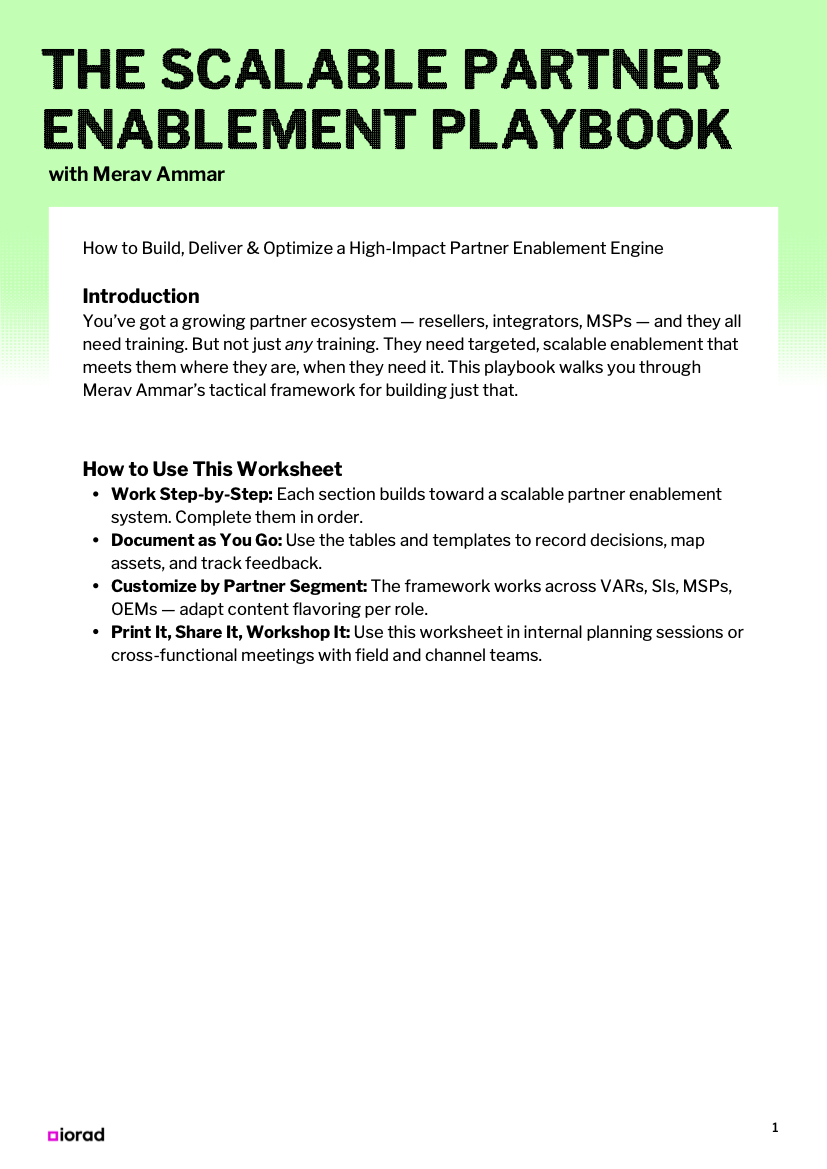
Scalable Partner Enablement
How to build, deliver, and optimize a high-impact partner enablement engine.
Download