Join Ryan Orner to learn how early adopters, manager enablement, and real-world use cases combine to make champion networks work in practice.
Meet our guest
Ryan’s path into tech is anything but traditional. He began his career in law enforcement, moved into college athletics as a head coach, and ultimately found his way into customer success leadership at HubSpot. Across every role, a few themes stayed constant: helping people perform under pressure, building high-performing teams, and translating complexity into action.
Those experiences became especially relevant when Ryan was asked to help roll out an internal AI-powered Customer Success Assistant. The tool was powerful—but power alone doesn’t drive adoption. What mattered was how people actually used it in their day-to-day work.
Ryan Orner Senior Manager, Customer Success Management @ Hubspot Connect with Ryan
Key Takeaways from this episode
✅ Champions should reflect the organization, not just top performers.
✅ Early adoption must happen before formal rollout.
✅ Peer reinforcement beats top-down mandates every time.
Adoption Doesn't Start at Launch. It Starts with Trust
Background context: When Ryan’s team first introduced the AI tool, they didn’t immediately form a champion network. Instead, they quietly placed it into the hands of early adopters—CSMs already experimenting with AI and new workflows.
There was no heavy structure. No rigid program. Just real work. “We told them: use it, break it, pressure test it—and tell us what doesn’t work.”
This early group surfaced practical use cases, prompt examples, and friction points long before the broader organization ever saw the tool.
By the time the official rollout happened, the tool already spoke the language of real users.
Key Insight #1: Seed Adoption
When it was time to build a formal champion network, Ryan made a deliberate choice: include skeptics.
Not everyone in the network loved AI. Some questioned its accuracy. Others worried about job displacement. Ryan wanted those voices represented.
“We wanted honest feedback, not cheerleaders.”
This created a champion group that:
Reflected real concerns across the org
Built credibility with peers
Surfaced objections early, before they stalled adoption
Adoption spread because it felt authentic—not forced.
🎤 “We wanted honest feedback, not cheerleaders.” - Ryan Orner
Key Insight #2: Design Champions as Messengers
Champions weren’t asked to become enablement professionals. They weren’t running formal training sessions or building content libraries.
Their role was simpler—and more powerful:
Share real examples in Slack
Talk openly about wins and failures
Normalize experimentation
Because champions were respected peers, their stories carried more weight than any official announcement.
Key Insight #3: Position as a Friction Reducer
At HubSpot’s in-person CS onsite, the rollout wasn’t framed as “Here’s a new AI capability.”
Instead, the message was: “We heard your friction—and this helps remove it.”
Ryan’s team connected the tool directly to:
Call prep time
Information overload
Post-call follow-ups
🎤 “We were able to say: we listened—and now here’s something that actually helps.” That framing changed everything.”— Ryan Orner
The Problem: Teams know they need champions—but don’t know how to structure them. As a result, champion programs become informal, uneven, or unsustainable.
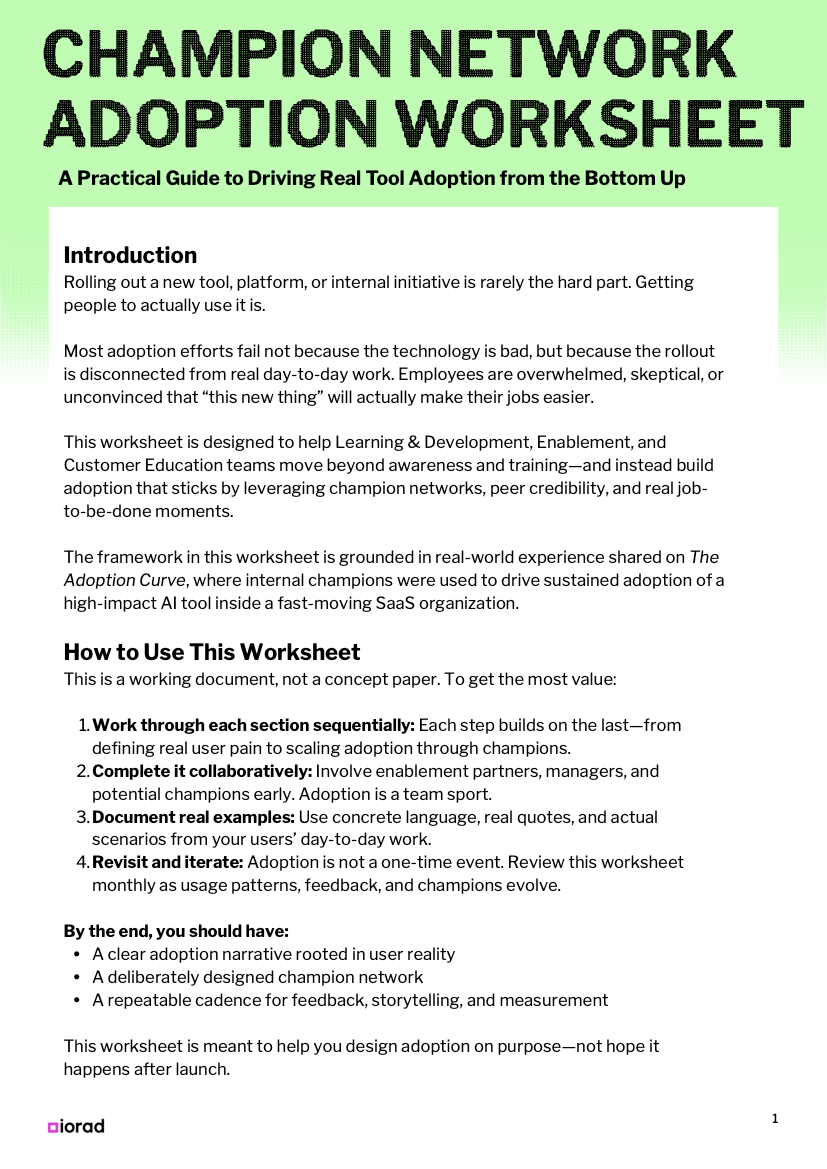
How it works: The Champion Network Adoption Worksheet helps you intentionally design adoption instead of hoping it happens.
Identify early adopters already experimenting
Select champions who are trusted peers (not just top performers)
Balance believers and skeptics
Map real workflows where the tool removes friction
Define where champions share stories and examples
🎤 ““The champions had to be respected voices—not just high performers."— Ryan Orner
Champion Network Adoption
Learn how to rollout a new tool, platform, or initiative by leveraging champion networks.