

Meet our guest
Nia’s work sits at the intersection of psychology, learning design, and sales performance. With a background rooted in psych neurophilosophy, she approaches enablement with a different question than most teams ask. Not what content should we create? but what friction can we remove?
In her role, Nia focuses on designing adoption-first experiences for sellers—onboarding programs, sales kickoffs, all-hands meetings, and day-to-day workflows that make it easier for teams to sell and easier for customers to buy. Her philosophy is simple but powerful: enablement only works when it fits naturally into how people already think, feel, and work.
.webp?width=300&height=300&name=Ni_Li%20(1).webp "Ni_Li (1)")


The Hidden Cost of “Just One More Training”
Background context: Most enablement programs are built with good intentions. Leadership identifies a gap, enablement designs a solution, and training gets rolled out.
But Nia has seen what happens next far too often: attendance without engagement, completion without confidence, and tools that technically ship—but never truly land.
The problem isn’t that sellers don’t want to learn. It’s that most learning experiences are disconnected from the moment someone actually needs help.“People don’t go to training because they want to learn something new. They go because they want to get unstuck or be more efficient.”
That insight reshaped how Nia designs everything from onboarding to sales all-hands. Instead of starting with slides or curricula, she starts with a single question: What is this person trying to do right now—and what’s getting in their way?
Key Insight #1: Design for the Moment of Need
Early in her role, Nia didn’t assume she understood sellers’ workflows. She asked them to show her. Not in surveys. Not in theory. Live, in real-time with walkthroughs of how they actually worked.
• How do you use this tool today?
• Why this way instead of another?
• Where does this fit into your day?
That reality became the baseline for every enablement experience that followed. Enablement stopped being something sellers attended and started becoming something they used.
🎤 “If it’s not something they can apply immediately—either during or right after—their brain is just going to forget it.” - Nia Li

Key Insight #2: Trust Comes Before Adoption
One of the most powerful ideas Nia shared was this: Enablement shouldn’t feel like training. It should feel like a safety net.
Behavior change is emotional before it’s technical. If people don’t feel safe trying something new—or failing in front of peers—they won’t change how they work. That’s why Nia prioritizes:
• Curiosity over compliance
• Empathy over enforcement
• Relationships over rollouts
🎤 “You’re trying to change behavior. That can only happen when someone feels psychologically safe.”— Nia Li

Key Insight #3: Peer Influence Beats Top-Down Enablement
At TierPoint, even sales all-hands are treated as adoption moments. Instead of data-heavy updates, the focus is on:
• Recent wins
• Peer stories
• How deals were actually won
Top-performing sellers don’t just get praised—they explain their process. What they tried. What worked. What they’d do again. That peer reinforcement creates momentum no enablement team could manufacture alone.
🎤 “When it’s peer-to-peer, it lands differently. It’s not a mandate—it’s proof.”— Nia Li

Free Adoption Template: Enablement Experience Design Checklist (The Know – Feel – Do Framework)
The Problem: Most enablement focuses on what people should know—and ignores how they should feel and what they must do next.
The Know - Feel - Do Framework:
- Know - What is the one thing they need to understand?
- Feel - What emotion will help (or block) adoption?
- Do - What action should they take immediately?
- Remove - What friction can you eliminate right now?
- Reinforce - Where will this show up again in their workflow?
🎤 ““If they can’t apply it immediately, it’s just noise."— Nia Li
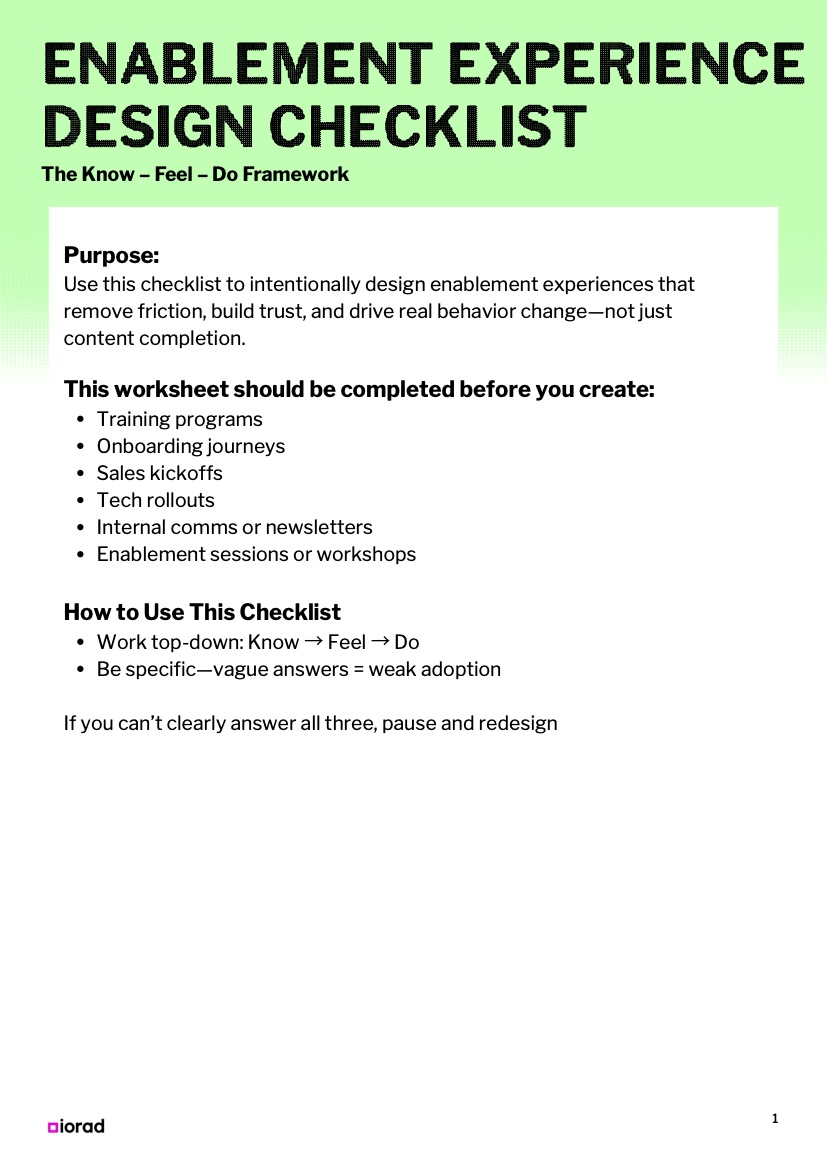
Enablement Experience Design Checklist
Design enablement experiences that remove friction, build trust, and drive real behavior change—not just content completion.
Download