

Meet our guest
Stephanie Flint is the VP of Global Training & Learning Development at ResultCX. With 25+ years in contact center operations, workforce management, and global training leadership, Stephanie has seen firsthand what happens when onboarding is built for content coverage instead of confidence.
Her work today sits at the intersection of scale, technology adoption, AI enablement, and frontline performance, and her recent healthcare rollout revealed something critical:
Attrition isn’t always a culture problem. Often, it’s a confidence problem.



Building Adoption-First Training Programs That Actually Work
Background context: In high-volume environments like BPO and healthcare support, training isn’t just about knowledge transfer — it’s about operational stability. If a new hire leaves during their first week, performance drops, costs rise, client confidence erodes, and team morale suffers.
Stephanie’s team saw attrition spike at two critical moments: Day 3 of training and Day 1 on the phones. As they investigated further, the root cause became clear. “As a human, if we don’t have everything we need to be successful, we’re probably going to jump ship.” This wasn’t a motivation problem. It was a preparedness problem.
Agents were expected to support a complex healthcare payer program that required navigating 30 different systems, yet many didn’t receive full credentials until late in training. That created a dangerous gap: employees were expected to perform without meaningful hands-on practice. When they finally reached the phones, anxiety spiked. “We were losing the highest amount of people within the first three days. The separation type was no call, no show.” Exit interviews revealed a consistent theme — not unwilling, but unprepared. They didn’t leave because they didn’t want the job. They left because they didn’t feel confident they could do it.
Key Insight #1: Tool Access is a Retention Strategy
Most organizations treat system provisioning as an IT process.
Stephanie reframed it as a learning strategy.
If learners can’t log in, can’t navigate tools, can’t visualize workflows — confidence collapses. Instead of waiting for credentials, her team decided to simulate access.
🎤 “Being able to do your job effectively and getting the tools to do it is part of retention.” - Stephanie Flint

Key Insight #2: Interactive Simulation Changed the Curve
Initially, the team tried building manual screenshots across 30 systems. “That was the death of us.” - Stephanie Flint
Then they implemented interactive workflow simulations using iorad.
Learners could:
• Practice logging in
• Navigate real workflows
• Make mistakes safely
• Build muscle memory before they go-live
They ran a pilot:
• 4 classes with traditional training
• 4 classes with simulation-based onboarding
The results:
• 📉 20% reduction in attrition
• 📉 Traditional cohorts saw over 30% attrition
• 📈 Significant increase in learner confidence scores
When surveyed, those in the simulation cohort consistently reported feeling more prepared. Confidence wasn’t a byproduct. It was engineered.

Key Insight #3: Adoption Starts Before Performance is Required
Stephanie reframed onboarding around one core principle:
Exposure before expectation.
Training stopped being about finishing five weeks of curriculum. It became about ensuring someone felt capable before taking their first call. That shift changed the business outcome.
🎤 “Whether or not they get access to the system, our goal is to expose them. Confidence is part of retention.” - Stephanie Flint

Free Adoption Template: The Attrition-to-Adoption Playbook
The Problem: High early-stage attrition caused by tool overwhelm and low confidence. Most onboarding programs focus on content completion. Few focus on psychological readiness.
The Solution:
1. Identify the Drop-Off Moment - Pinpoint exactly when attrition spikes occur.
2. Run a Root Cause Analysis - Is it manager support? Culture? Tools? Clarity?
3. Simulate Before Access - Don't wait for provisioning. Create interactive system simulations.
4. Pilot in Parallel - Run A/B cohorts to measure confidence and retention.
5. Scale what Reduces Anxiety. Find what works and double down on it.
🎤 “Exposure builds confidence before performance is required."— Stephanie Flint
Why it works:
The framework shifts training from knowledge transfer to capability building.
Instead of asking "did they complete the course", you ask, "do they feel ready to perform". That distinction determines retention.
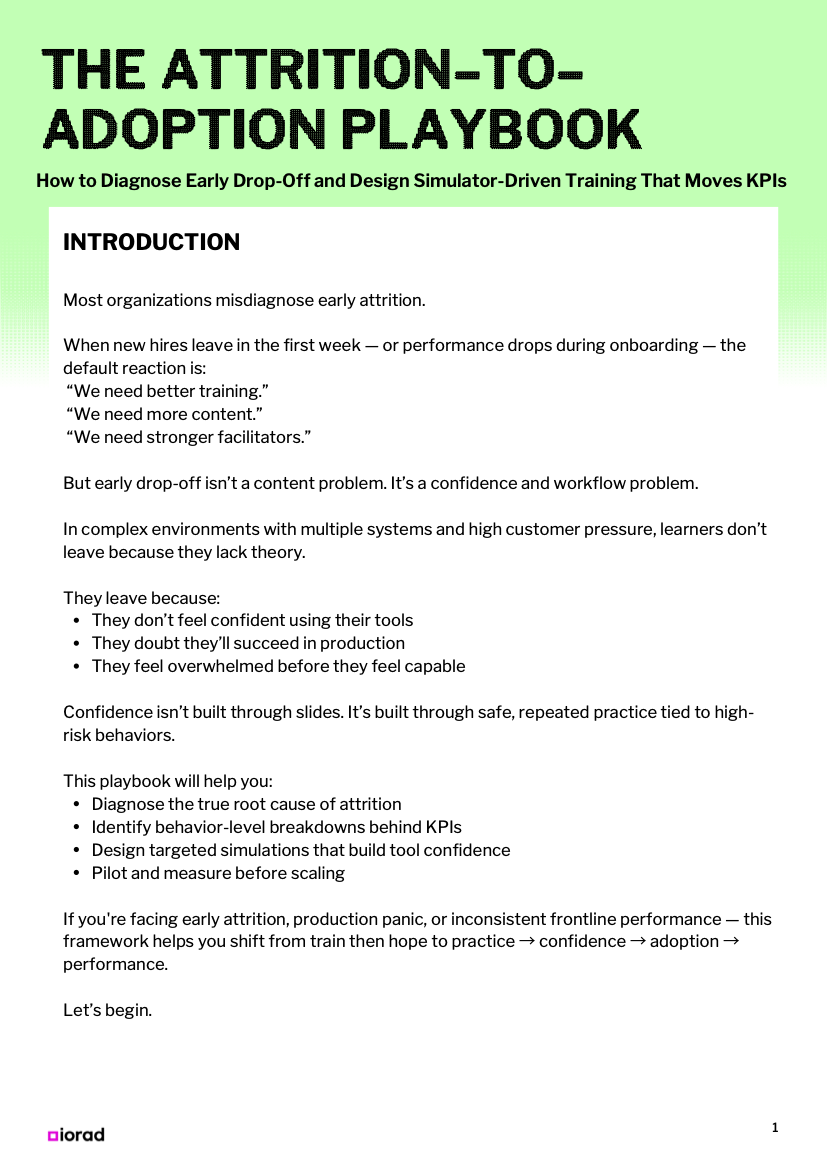
Attrition to Adoption Playbook
Learn how to diagnose early drop-off and design simulator-driving training that moves KPIs
Download